
Cultural Fusion Origins
The fascinating merging of storytelling that focuses on Black inner-city neighborhoods and the art of the 90s has resulted in a unique cultural phenomenon. Besides, a great number of creative works that have come down to us from this very period look as if they were created in a surreal, almost delirium-like state. The artists of these pieces often use bizarre psychedelia to work, and they would gain a lot from the strong counter-cultural perspective that is very clear to be seen in them. As a result, such landmark instances as Hype Williams’ movie “Belly” and the Wu-Tang Clan’s album “Return to the 36 Chambers” are found not in the categories but rather in the in-between of the social-political critique and the raw emotionality and daring visual diversity.
Furthermore, the origins of this movement extend backward and interconnect across numerous cultural layers. These roots significantly draw from the gritty, exploitative Black cinema of the 1970s. Simultaneously, they connect deeply to the transgressive energy of underground pornography, the complex rhythms found within funk and jazz record collections, and, crucially, the unique lived experiences existing in the shadow of the unattainable American Dream. Therefore, this artistic expression grew directly from a complex web of marginalized experiences and defiant creative responses.
Artistic Longevity Challenge
Individuals who navigated and thrived within this intense environment have rightfully become legendary figures. However, a strong argument suggests their later artistic outputs have gradually shifted towards a zone of safer, more predictable work. For instance, when was the last truly groundbreaking project released by influential figures like RZA or Spike Lee? In my opinion, it is really a tough task to keep the energy extreme, transgressive, and to use it for such powerful art for a long time. Basically, artists encounter a very tough decision: they can either deliberately disengage from that unstable source of inspiration or they can continue to create by drawing on the vastness of their fiery currents. Importantly, whichever path is taken inevitably shapes the resulting art. There truly is no effortless escape from this fundamental tension.
In my opinion, it is really a tough task to keep the energy extreme, transgressive, and to use it for such powerful art for a long time. Basically, artists encounter a very tough decision: they can either deliberately disengage from that unstable source of inspiration or they can continue to create by drawing on the vastness of their fiery currents. Freddie Gibbs background growing up in Gary, Indiana is one of the most important things that shaped his style of gangster rap, as “murder capital of America” was a place very close to his heart.
Gibbs, year after year, keeps bringing to the surface the same raw truth and rough-life-experience vibe through his songs. Moreover, he has an impressive facility to move smoothly through complex rap tricks while painting clear images of the less fortunate aspects of the streets. In fact, he does all this with a deep grasp of the sadness and struggle beneath the themes.
The Alfredo Collaboration Peak
While he has been very successful as a solo artist, it is probably Gibbs’ most outstanding artistic accomplishment, his 2020 joint album with The Alchemist, named “Alfredo,” that stays beyond competition. It is a very good example of the best moment of their career, where Gibbs’ stories from the street and The Alchemist’s moody, sample-rich production were combined in a perfect way to give birth to a unique and wonderful piece of work. Consequently, “Alfredo” solidified Gibbs’ position as a vital voice capable of channeling the raw power of his influences into contemporary, critically acclaimed art.
Atmospheric Contrast with Boldy James
The Alchemist’s extraordinary teamwork with Boldy James – The Price of Tea in China – had almost the same impact on listeners as Freddie Gibbs’ Alfredo, but the latter offered a very different sound. While The Price of Tea in China was firmly anchored in a gritty, late-night reality, frequently interrupted with fragments of news and the monotony of the struggle between fatherhood and drug dealing, Alfredo seemed to evoke less tangible things. It gave a feeling as if it was the night, the lullaby, the dream of the harsh world faded: the outlines were less defined, the characters became psychedelic, and Alchemist’s beats were coming apart like smoke in the air, thus making the place an often formless, hanging one.
As a result, Alfredo was on its way to becoming one of the present-day masterpieces, a status that was later recognized through the smart album cover that ingeniously combined a picture of mouth-watering fettuccine with the famous logo of The Godfather. Frankly, it remains surprising that it didn’t make BPM’s year-end top 50 list in 2020, though the disorienting nature of the pandemic lockdown likely caused many things to be overlooked. Given its now legendary reputation and the potent Godfather reference embedded in its title and cover, it logically follows that a sequel eventually emerged. However, the key twist is that Alfredo 2 deliberately avoids simply copying the sound of its celebrated predecessor.
Visual and Sonic Rebranding
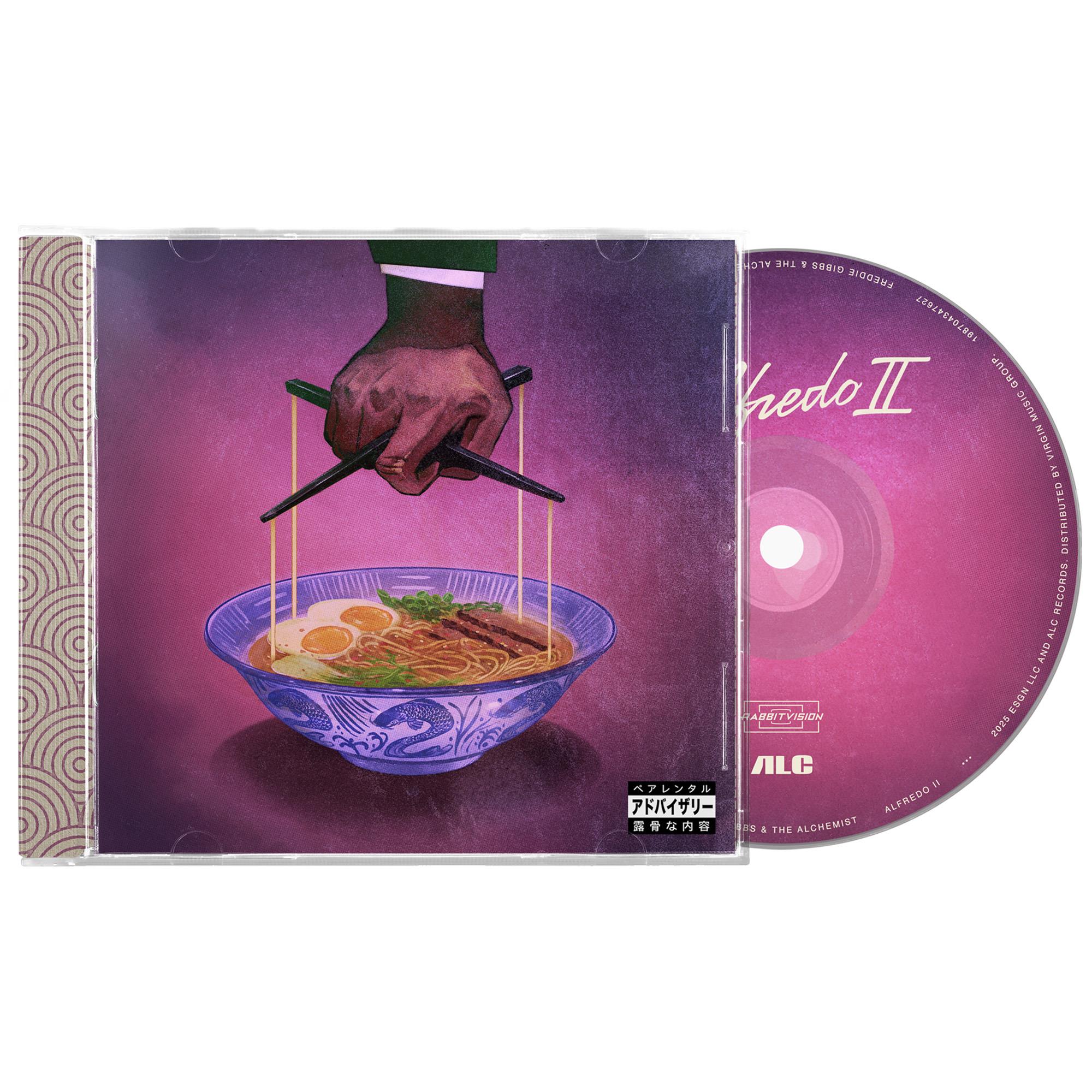
Notably, Alfred 2 has been changed momentarily in terms of characterization, and the rich husky, low-key brown colors of the original cover have been replaced with a strong, striking magenta that really pops out. In a similar manner, the artistically beautiful pasta dish has been replaced with an inviting, hot bowl of ramen, which can be interpreted as the changing of the reference points. What is more, the very heart of the album undergoes a drastic change.
Alfredo 1, being dark and mysterious, shadowy, and dreamlike, for most of its duration had the audience wandering through the night; however, Alfredo 2 breaks that pattern and definitely feels like it could take place in the daytime. You can tell that the mood is less heavy and more lighthearted; the whole album gives off the vibe that it is more laid back, and almost more accessible and almost like it is soaked in a nice sunny atmosphere. Sonically, it brought to mind the perfect boat image that Tyler, the Creator, in a very vivid way, talks about in his song “Something to Rap About,” which is like a metaphor for tranquility, slow movement and vastness of the place.
Alchemist’s Jazz Fusion Palette
The Alchemist really made a lot of his best recent production work known in Alfredo 2. For most of the album, he mixes layering complex, jazzy, and somewhat psychedelic fusion pieces that musically can be traced through the late 1960s and early to mid-1970s, giving the listener an intimate, earthy vibe. It is still not uncommon for the tracks to have some instances of the very same effects used earlier, where the instruments become a bit indistinguishable, and the voices reverberate in the emptiness, but these effects now give a different feeling. Instead of smoke dissipating, it now resembles watching vibrant paint being gently washed away in clear water – the movement feels more directional, and the colors retain their presence even as they blend and flow, a technique masterfully employed on tracks like “Empanadas.”
Meanwhile, Freddie Gibbs responds to these shifting soundscapes with another vocal tour de force. He manages the intricate flow of his work with unbelievable exactness, going through the producer’s fading, fluid materials in a manner that is always perfectly sharp and controlled. His poetic content, by necessity, cycles through sex, death, and drugs, but now these topics appear with the same (un)expected frequency as one would encounter during a trip to the local grocery store. More to the point, though, they inhabit a much bigger realm of seriousness and suffering, reflecting the same kind of brutal, disorganized truth that an artist like Ol’ Dirty Bastard used to relate his own life experiences.
Additionally, a keen ear can pick up on a slight emotive crack in Gibbs’ voice on this album. This vulnerability beautifully enhances the album’s overall reflective tone, powerfully magnifying his evident growth, both as a mature artist and within the often harsh realities of the street scenes he continues to document.
Album Structure and Consistent Quality
Furthermore, Alfredo 2 contains a total of 14 distinct songs, spanning a runtime of 48 minutes. This makes the album noticeably longer than the original Alfredo. Though the new album is longer than the previous, the listener doesn’t get the impression at any time that it is too long or boring. Crucially, the LP is filled with the tracks that could be called the album’s highs. These high points vary from the already very popular “1995,” – which sonically is the closest to the first album’s signature style – to the strange, 80s-inspired, dark and mysterious “Skinny Suge II.”
Moreover, the record also features the lovely, love-song, with softcore-style vocals “I Still Love H.E.R.,” and the vintage-future, orchestral “Gas Station Sushi.” As a result, it turns out to be quite difficult to find a single low or less attractive moment in the whole body of work; the level of quality is kept very high consistently throughout the project.
Mainstream Appeal Highlights
Simultaneously, a track like “Ensalada” prominently features Anderson .Paak delivering a memorable chorus. Moreover, it provides an incredible instrumental hook built upon a laid-back guitar backdrop. This combination arguably sets a new standard for sheer listenability within the collaborative union of Freddie Gibbs and The Alchemist. In fact, “Ensalada” possesses the genuine potential to become a legitimate radio hit capable of crossing over into the mainstream audience. Similarly, “Shangri-La” stands out as another major highlight in this accessible vein, it skillfully recreates a familiar, early 2000s millennial R&B-rap sound that resonates widely.
Artistic Depth and Balance
Nevertheless, if this increased accessibility concerns listeners fearing a loss of the project’s abstract edge, a track like “Gold Feet” immediately alleviates those worries. Featuring sprawling, resonant piano notes and an incredible, technically impressive verse from guest rapper JID, “Gold Feet” remains refreshingly artsy and pleasantly strange. Its experimental quality easily rivals the most formless, avant-garde experiments found on the predecessor album. Furthermore, the warm, inviting soundscape of “Jean Claude” incorporates a sonic texture reminiscent of the orange glow unique to Miami sunsets. Here, Gibbs thoughtfully ponders the cyclical “in and out” nature of the rap game, thoughtfully connecting it to his personal relationships and loyalty to his crew. Ultimately, “Jean Claude” stands as an absolutely wonderful track that simply could not exist within the more ominous and melancholic sonic world of the first Alfredo.
Sequel Comparison Challenge
Consequently, this brings us to the significant question: does the sequel album surpass the original in quality? One significant thing, however, is that this research question can hardly be answered by a simple “yes” or “no”, and this is a very strong point that brings out the artistic strength of both projects profoundly. There is no best or worst in the works; they are just different expressions of the artists, each with its own special features. Besides, the iconic transition from the very first album cover that was just a picture of fettuccine to the sequel showing ramen is quite a nice metaphor here: the new one is not what the audience would have guessed. Rather, it offers a more elaborate and intricate taste profile, using more varied ingredients, and giving a deeply comforting, and maybe even a slightly spiritual, listening experience that is different from the original’s gloomier tone.
The Protagonist’s Shifted Perspective
Moreover, Freddie Gibbs’ narrative persona within this sequel remains actively engaged in street life, yet he appears noticeably more settled into a structured, routine lifestyle. This new stability thus opens up for real instances of unwinding and getting in touch with the emotions all over the lyrics. One of the most important aspects is the lesser presence of paranoid feelings that leak into the songs and the fewer dark areas that are there to find. Rather, Gibbs talks more and more about bright, near to the magical and purposely mixing of the holy and the unholy things – like going up a very high mountain while on drugs or having a sexual climax in the silence of a church. Collectively, these references construct a potent image of the quintessential American anti-hero, evolved from his previous incarnation.
Cinematic Influence Evolution
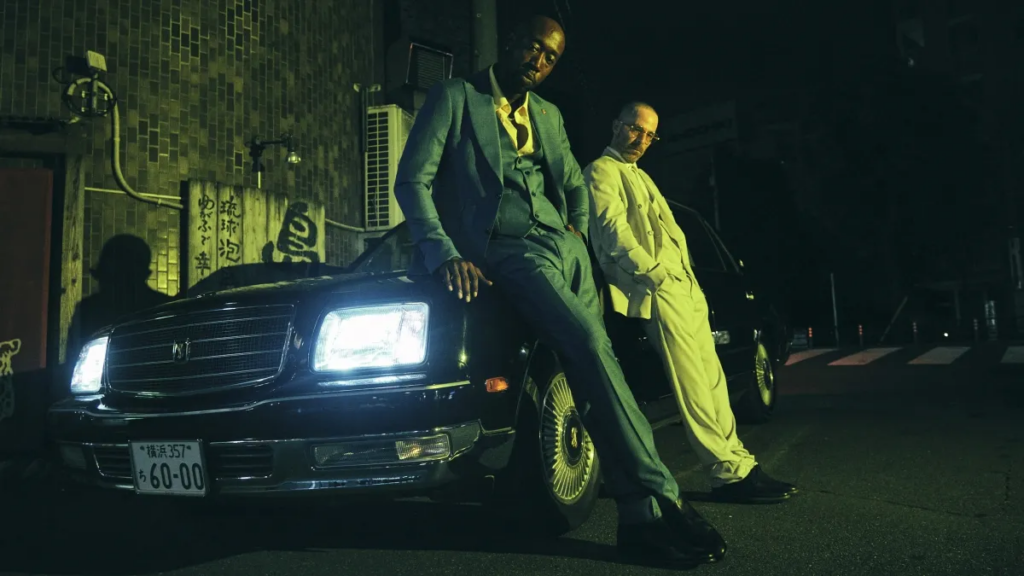
Whereas the original Alfredo seemed profoundly haunted by the volatile energy of Martin Scorsese’s iconic insomniac anti-hero, Travis Bickle from Taxi Driver – portraying a tense journey along the jagged edge of reality within a perpetually nocturnal, menacing version of New York City – the sequel consciously channels a completely different cinematic sensibility. It embodies the impressionistic cool and deliberate calm famously associated with Takeshi Kitano’s yakuza protagonists: impeccably well-dressed, remarkably laid-back even when confronted with sudden violence, surrounded by vibrant colors, and projecting a deeply Zen-like acceptance of their chaotic world.
I can say that from my own perspective and strictly personally that I feel, for sure, more of an inside connection with the surreal, oneiric atmosphere that the first album gave, its ever-vaporous, smoky, and deeply melancholic musical ballads, I really liked. But on the other hand, it can not be denied that Alfredo 2 has a more thoughtful overall construction and a wider stylistic diversity and as well as the sonic color. The album 2 is even more noticeable in its track list as it achieves a stronger coherence between the songs. Sometimes, it even gives the listener the impression of being a concept album telling in detail, one long, coherent story. Additionally, this assessment doesn’t even account for how perfectly it serves as an exceptional summer listening experience, radiating warmth and ease.
Final Verdict Nuance
After all, Alfredo 1 & 2 albums are like the legendary Godfather film series. Choosing one as the absolute best really tells you more about the personal taste and biases of the critic than about the actual quality of the work. On a basic level, Alfredo 2 is just as wild from a sonic point of view, as creatively daring and as emotionally thrilling as the first Alfredo had been with its historic release five years earlier. These are two masterpieces that present a complementary reflection of the different stages of the artist’s path.