
Mike Leigh Quits Directing Due to Illness
Mike Leigh and his partner, the actor Marion Bailey, were knocking around at home last Christmas looking for a good film to watch and constantly coming up short. Finally, Leigh had a brilliant idea, and they watched Topsy-Turvy, Leigh’s 1999 costume film, a light-hearted depiction of the making of The Mikado. This way they finally got a good movie to enjoy together. “It’s not like a habit,” he quickly said and added, “I don’t sit there watching my films every night like Gloria Swanson in Sunset Boulevard. It’s just that Topsy-Turvy really is just a very enjoyable watch.”
Leigh describes his own films as his children who went away from him, but the bond they share is the reason why it’s still good to see them occasionally. Some are bright (Life is Sweet; Happy-Go-Lucky), and some are dark (Naked; Hard Truths), but they are all made from the same mould, the same real-life concerns, and the same tragicomic outlook. He can’t pick between them, and he would defend any one of them to the death. Then he pauses and admits it is the “Meantime” that gives him particular joy.
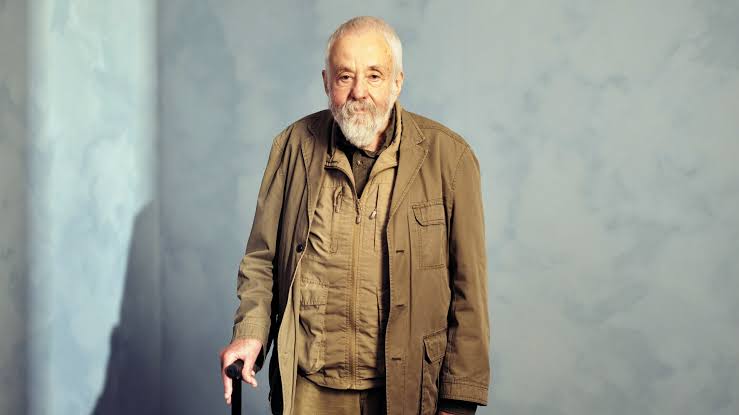
At the age of 28, Mike Leigh directed his first film, called Bleak Moments. He turned 83 on the set of his 17th film, “Tender Loving Care”. Thus, his filmmaking family has grown quite well, almost his own lineage, but his latest, youngest child is very likely his last. Myositis, an inflammatory condition which causes the loss of muscle strength and movement limitation in his case, has prevented Mike Leigh from continuing his movie-making. “I’m not retiring,” he said, adding, “I’m going to sit down and write something.” However, he added that he physically cannot continue directing films anymore.
Mike Leigh Reflects on His Final Film and Changing London
I don’t fancy picking out a particular film as the most special one for him because each of his works carries its own unique magic: humdrum magic in a sense; broken saints; cracked clowns… All these are somehow represented in each of the films. Tender Loving Care, in the same vein as the female friendship element in Career Girls as well as the image painting of a happy pair of old people in Another Year, picks its own path through a modern-day London that is in trouble. The main actors of the two young women, who are both social workers drowning in cases and trying to do good, are Kate O’Flynn and Alice Bailey Johnson (the daughter of Marion Bailey). Paul Jesson and Bailey play the couple of older people, Amy’s parents. The story of Tender Loving Care revolves around the everyday life of people who are doing their best to cope by self-medicating with white wine and singing songs to keep up their spirits. He captures and tells of the ways people love and help one another; how amazing that is, the fact that it is rarely sufficient.
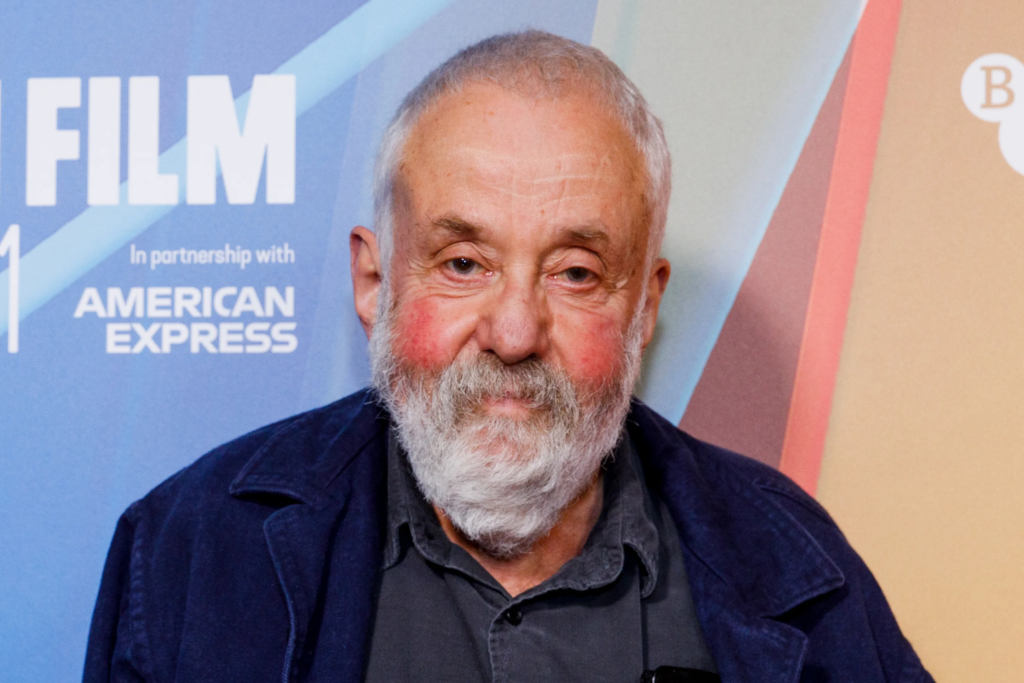
The date is quite a grey November day when I pay a visit to Mr Leigh at his film distributor’s office in King’s Cross, London. He is in the chair by the entrance of the office, wrapped tightly in a gilet. As usual, his beard seems snow-white. His walking frame is not far away from there. He brusquely apologises for not getting up. King’s Cross was the setting for his 1988 film, High Hopes, with its gasworks and grungy Victorian estates. Now it’s a place of glass-fronted office blocks, shops and restaurants. “The spot where we are sitting is literally Shirley and Cyril’s former flat,” he says. “It was right here; now it’s gone. It has all been swept away.”
Mike Reveals the Filmmaking Method Behind His Award-Winning Career
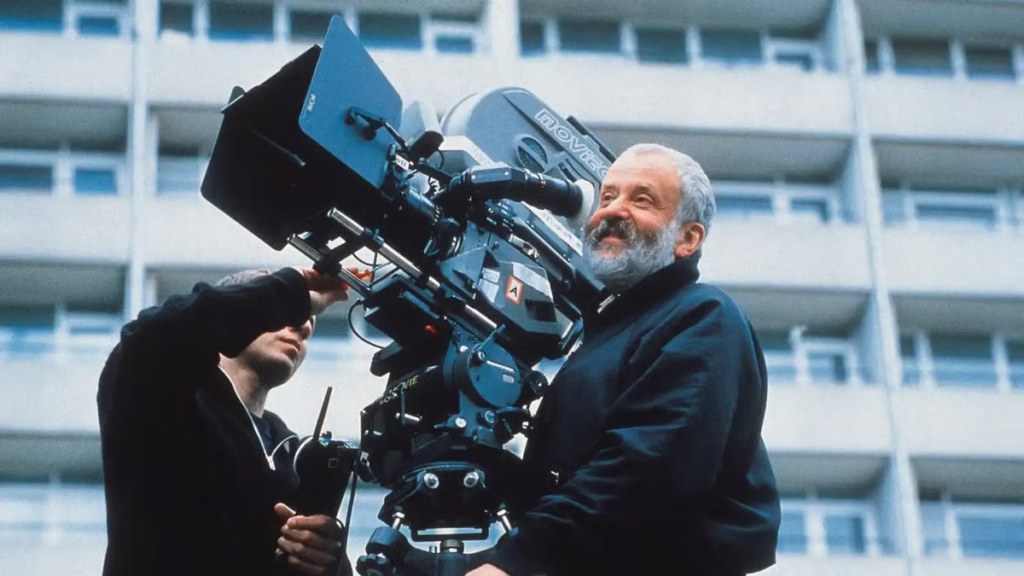
At least some things never change. Mike Leigh has been creating films in the same hand-tooled fashion since Ted Heath was Prime Minister. Every one of his movies is the fruit of a months-long rehearsal. His actors get involved in developing characters and sketching scenes, and then he runs his films to the end, like a trained hunting dog chasing a scent on the breeze. “We start with improvisation, distil it down to a precise piece of action and then shoot,” he says. “It’s like digging the foundations or mixing the paints.”
The filmmaking industry is typically structured in a very hierarchy-driven way. Through his words, he makes it sound collaborative, inclusive, and even borderline democratic. To the extent that he is a director, it’s as though he’s not the director so much as the facilitator, the guide, or the conductor of an orchestra.
“Well, yes, all those things,” he agrees. “Also the author. The dramatist.”
What about the host of a literary salon? “Well, I don’t know about that,” he says, wincing. “You’re slightly devaluing it now.”
Leigh’s way works. He’s won the Palme d’Or, three BAFTAs, and the Venice Golden Lion. Still, it goes against the normal business plan, and raising money became difficult. In the movie business, you get funding from investors who like big stars. But here he has no script to offer, and he refuses to work with big stars at all to attract potential investors to finance it. Some investors can, he says, pretend not to notice the script. But a big name is always at the top of the demands list. That’s why the A-listers sell the movies.”
Leigh Explains Why He Rejects Hollywood Stars as Illness Worsens
Why not cast a name? How bad can it be? Leigh has a group of reliable British character actors (Jim Broadbent, Ruth Sheen, Lesley Manville, Timothy Spall) whom he greatly respects. However, even in Hollywood, big names can on occasion be good actors as well. I believe quite a number of them would have been really excited to be collaborating with Leigh.
“Why not a famous-name actor?” Leigh snorts at this suggestion; he is at once amused and irritated by the question. “Firstly, we need to understand exactly what it entails. You – the name actor – would have to commit yourself to the project for months on end. You may have to get out in the real world and do some research. Besides, it may be the case that you will not even be playing a character that fits how you want to be perceived by the public, the idealised version of your own personality. Finally, it will be a source of distraction. One starts from the assumption that the movie is basically a vehicle for the actor, and that is one point I strongly disagree with. It’s not on. It’s dangerous. And yes, it might be all right, but the foundation is all wrong.” He shakes his head. “For instance, if someone were to tell you, ‘The reason you messed up and failed is that you didn’t get star names’, then with the utmost humility I’d accept it. But that simply isn’t the case.”
Leigh acknowledges that making films has indeed grown harder; he’s not denying the fact. He says Tender Loving Care, for instance, had to be cobbled together at speed on a minuscule budget. By that stage, he already had other obstacles that were getting in the way of his work. At the time, he did not know that this was the last film. “That’s come this year,” he says tersely. “Because this condition I’ve got, myositis, is just slowly getting worse. The film shoot went OK for my condition. Everyone was very helpful. I had to be moved around a bit. However, I’ve felt my mobility problems more lately, and I’ve got quite a few more issues with being physically independent since then.
Mike Leigh Says Myositis Means He Can No Longer Make Films
Maybe, perhaps, he wants to persist. Is that an option? Leigh is so idiosyncratic a film-maker that he can definitely come up with a film any way that he chooses. The level of his involvement in the film-making process – how active and present he is – will be entirely up to him. For example, He might decide to use a proxy; he could even be directing from a wheelchair.
I must be really at a loss; I’m trying everything. It’s driving him up the wall; he is desperate to shut me up. “Yeah, sorry,” he says, chipping in. “I’m very good at listening to everybody in the world – including you – telling me why I can keep working and how. And my answer to that begins with an ‘F’ and ends with an ‘off’.”
I think that probably every decent artist works within limitations. They have to spend money on the materials; they have their bodies – that is if they are in a state to go on; and their grandest, boldest visions often remain unrealised anyway. In the past, Leigh has somehow found the money to produce large-scale period films such as Topsy-Turvy, Mr Turner, and Peterloo. However, he would also have liked to make a big budget modern-day film as well.
“It will be the main thing that I will always regret,” he tells me. “The thing I wanted to do is now just not going to happen. A broad canvas and a contemporary subject. But I simply cannot see anyone supporting me, no one wanting their name on it.”
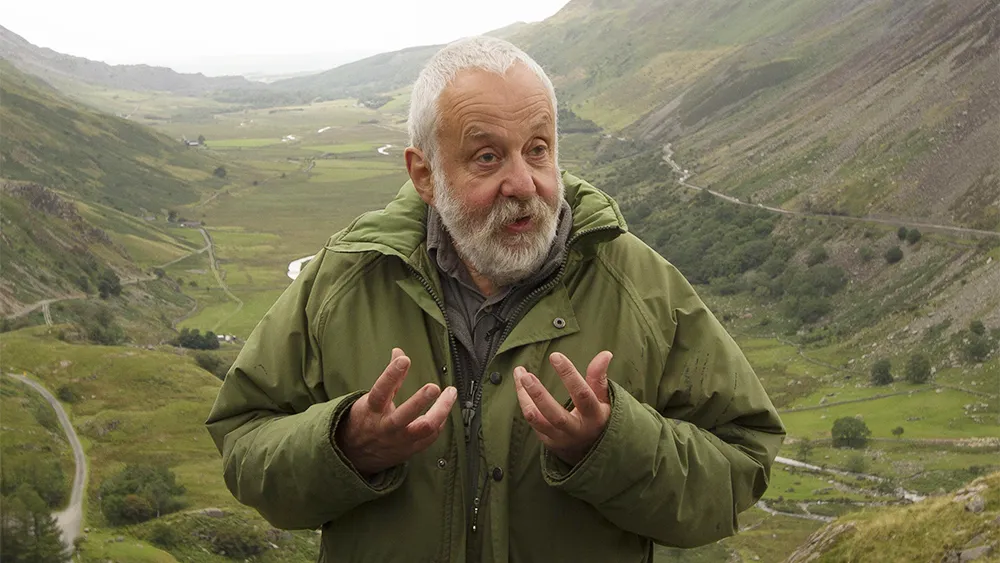
Mike Leigh Recalls Salford Childhood and BBC Rejection of His Drama Idea
He had a great idea for a film a few years ago. It was about a group of friends of different ethnicities and races. There was drama around their interaction, but he goes back to when they were their grandfathers, their ancestors, coming to the UK. “We put it together as a feature. I even wrote a document. And no one was interested. Then one of my producer friends said if we recast it as a television series, the BBC would jump on it. So we took it to the BBC. “We had a meeting with the head of content and her team, and she turned it down flat. She said, “We don’t know what we’re going to get.”
She hasn’t escaped his mind for a long time. “Well, I’m sorry, but with all due respect, with me, you never know what you’re going to get.”
He never got the job that was requested; they could not work him out. Leigh was brought up in Salford. His dad was a GP. He would listen to the coughing of his patients in the downstairs surgery. So far as childhood went, he was happy, but when he started to go towards drama, his father was horrified, telling him it was “the moonings of a stage-struck girly”. Nobody in Salford acted or directed. God willing, they’d be doctors and lawyers instead.